
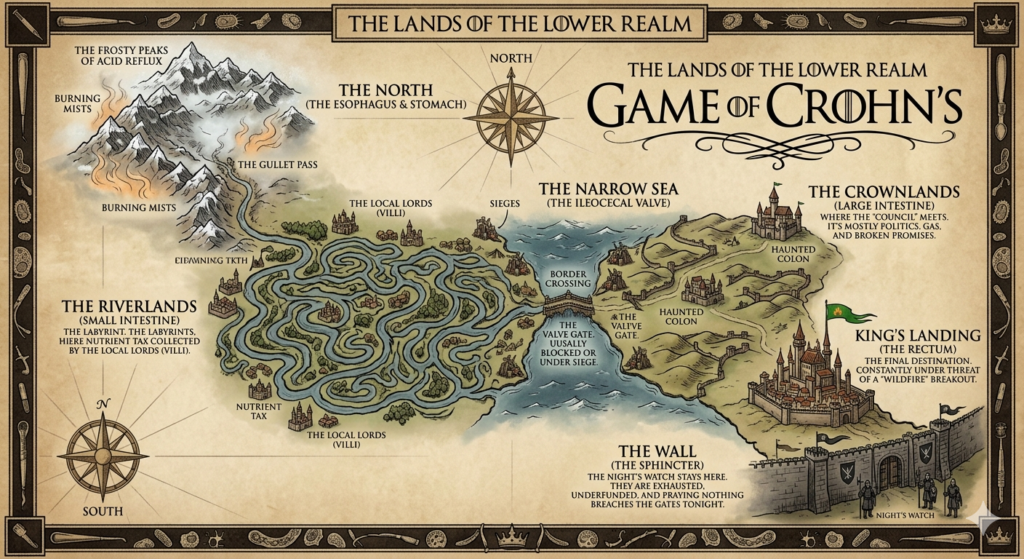
In the high-stakes strategy game of Inflammatory Bowel Disease (IBD), the medical establishment plays by a very specific rulebook. It’s a book written in the ink of clinical trials, double-blind studies, and the holy grail of “mucosal healing.” But for those of us on the front lines—the ones actually living in the trenches of Crohn’s and Ulcerative Colitis—the rulebook often feels like it’s written in a language we don’t speak, describing a landscape we don’t recognize.
This is where the “Game of Crohn’s” gets interesting. On one side, you have Medical Consensus: a rigid, evidence-based fortress. On the other, you have Experiential Wisdom: the anecdotal, hard-won “cheat codes” passed between patients in the dark corners of the internet subreddits and hospital waiting rooms. To survive this game and learn to thrive you need both, but the medical world is only just beginning to realize that the person with the scope in their hand isn’t always the one with the best road map.
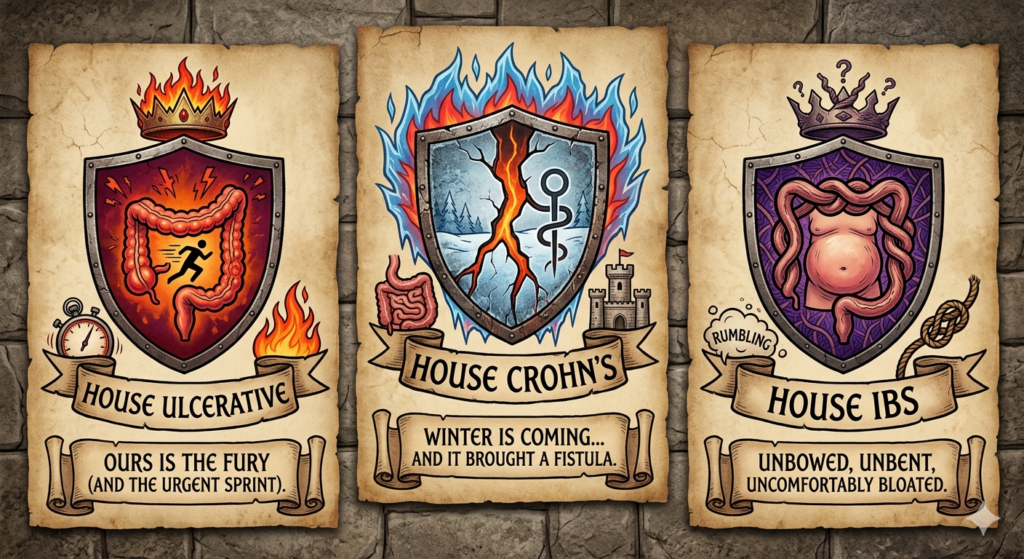
Know Your Lineage: The Great Houses of the Gut
Before you can master the strategy, you have to know which banner you’re fighting under. Every diagnosis comes with its own sigil and its own specific brand of chaos:
- House Crohn’s: “Winter is Coming… and it brought a Fistula.” Known for its unpredictable terrain and the ability to strike anywhere from the mouth to the “Wall.”
- House Ulcerative: “Ours is the Fury (and the Urgent Sprint).” A lineage defined by intense, localized battles and a constant need for a clear path to the nearest throne.
- House IBS: “Unbowed, Unbent, Uncomfortably Bloated.” The masters of the invisible war, where the bloodwork looks pristine but the internal siege never ends.
The Fortress of Consensus: Objective but Blind
Current medical consensus is obsessed with “Treat-to-Target” (T2T) strategies. The goal is simple: eliminate visible inflammation. Physicians rely on “objective” markers—C-Reactive Protein (CRP) levels, fecal calprotectin, and the dreaded colonoscopy—to determine if a patient is “well” (Turner et al., 2021).
The problem? Clinical remission and symptomatic remission are often two different countries. Research shows a significant “disconnect” between what a doctor sees on a screen and how a patient feels on a Tuesday afternoon (Sandborn et al., 2020). You can have a “beautiful” colon according to the Mayo Score, but if you’re still tethered to a bathroom and exhausted by bone-deep fatigue, the consensus has failed you. The medical model treats the fire, but often ignores the smoke that’s still choking the patient.
The Fog of War: Beyond the Physical
In any strategy game, the “Fog of War” represents the unknown—the mental and cognitive drain that isn’t visible on the map. In IBD, this manifests as extreme fatigue and “brain fog.” While clinical consensus focuses on the gut, experiential wisdom recognizes that the battle is also being fought in the mind.
Patients often report cognitive impairment and psychological distress that clinicians fail to measure because they don’t appear on a CT scan. This “extraintestinal” impact is a major part of the patient playbook, requiring strategies for mental health and cognitive pacing that aren’t found in a standard prescription pad.
The Rebel Wisdom: The Power of the N-of-1
Anecdotal wisdom is often dismissed by doctors as “noise.” But for a Crohn’s warrior, a fellow patient’s “noise” is often the only thing that makes sense. This is the realm of experiential knowledge—understanding that a specific brand of almond milk causes a flare, or that the “brain fog” isn’t in your head, even if it’s not in your bloodwork.
Narrative medicine—the practice of treating the patient’s story as a primary clinical tool—argues that these anecdotes are not just stories; they are data points in a complex, individual system (Charon, 2001). In the “Game of Crohn’s,” every patient is running their own “N-of-1” clinical trial every single day. We are the world’s leading experts on our own bodies, yet medical consensus often treats our “anecdotal evidence” as secondary to a lab slide.
Comparing the Playbooks
| Feature | Medical Consensus | Experiential (Game of Crohn’s) |
| Primary Goal | Mucosal Healing / Low Calprotectin | Quality of Life / Restored Agency |
| Validation | Peer-Reviewed Journals | “Does this let me leave the house?” |
| Timeline | 3–6 month check-ups | Hour-by-hour management |
| Authority | The Gastroenterologist | The “Gut Feeling” and Community Peers |
Tying it Together: Winning the Game
The “Game of Crohn’s” blog style reminds us that this isn’t just a biological malfunction; it’s a tactical challenge. When medical consensus says “there is no evidence that diet impacts Crohn’s,” and a thousand patients say “staying away from gluten saved my life,” the consensus is lagging behind the reality.
We are seeing a shift, however. The rise of Patient-Reported Outcomes (PROs) in clinical research suggests that the “ivory tower” is finally listening (Kim et al., 2022). Scientists are starting to realize that if the patient says they are suffering, they are suffering—regardless of what the biopsy says.
Conclusion: The Ultimate Cheat Code
In the end, medical consensus provides the armor (the biologics, the surgeries, the steroids), but experiential wisdom provides the strategy. You wouldn’t go into a boss fight without knowing the mechanics, and the best people to teach you those mechanics are the ones who have already lost a few lives trying to beat the level.
Don’t let a “normal” lab result gaslight you into thinking your symptoms aren’t real. In the Game of Crohn’s, your experience is the ultimate authority. Use the doctor’s rulebook to stay alive, but use the patient’s playbook to actually live.
References
- Charon, R. (2001). Narrative Medicine: A Model for Empathy, Reflection, Profession, and Trust. JAMA.
- Kim, K. N., et al. (2022). The importance of patient-reported outcomes in inflammatory bowel disease. Gastroenterology & Hepatology.
- Sandborn, W. J., et al. (2020). Dissociation between patient-reported outcomes and mucosal inflammation in patients with Crohn’s disease. Clinical Gastroenterology and Hepatology.
- Turner, D., et al. (2021). STRIDE-II: An Update on the Selecting Therapeutic Targets in Inflammatory Bowel Disease (STRIDE) Initiative. Gastroenterology.